The first gene map
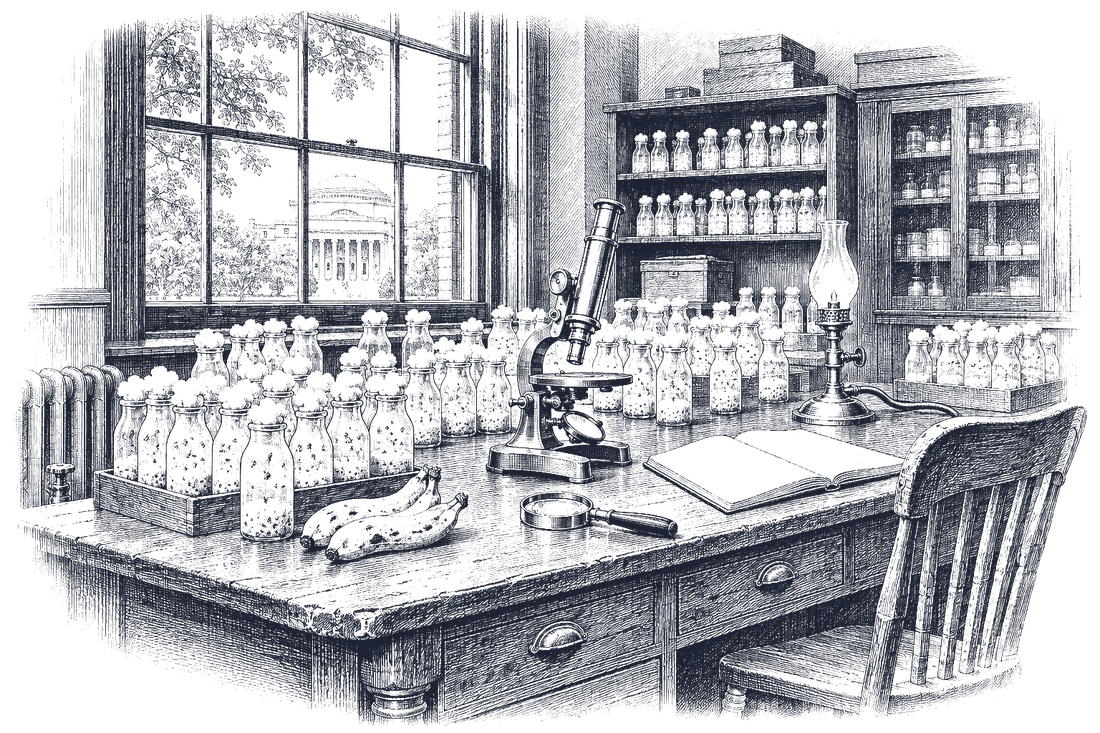
Alfred Sturtevant was an undergraduate in Morgan's fly room. Several genes were known to sit on the X chromosome, and they were sometimes split up when passed on.
Late in 1911 he took the fly counts home, skipped his homework, and spent most of the night drawing the first map of genes.
What is a genetic map?
A genetic map shows the order of genes along a chromosome and how far apart they are. Distances are measured not in micrometres but in how often two genes get separated when passed on.
Recombination frequency
When a mother makes an egg, her two copies of a chromosome can cross over and swap pieces. If a swap happens between two genes, the egg gets a new mix of them. The percentage of offspring with a new mix is the recombination frequency. One percent is one map unit, also called a centimorgan (cM), after Morgan.
Why sons
In Sturtevant's crosses the mother carried mutant versions of the genes on one X and normal versions on the other. A son gets his only X from his mother, so each son shows directly which X (or which mix of the two) he received. Daughters also get their father's normal X, which hides the recessive genes.
From percentages to a map
Sturtevant found that yellow body (y) and white eyes (w) were separated in about 1% of sons, white eyes and miniature wings (m) in about 34%, and yellow and miniature in about 35%. The numbers almost add up: 1 + 34 ≈ 35. That only works if the genes lie in a line in the order y – w – m.
Long distances come out a little short, because two swaps between distant genes put them back together. Sturtevant noticed this too.
His map and today's
Sturtevant's 1913 map: y 0.0, w 1.0, v 30.7, m 33.7, r 57.6. Today's map puts w at 1.5, v at 33 and m at 36: the order he found is still right.
What they found
When a mother makes an egg, her two X chromosomes can swap pieces. The farther apart two genes are, the more often a swap separates them. So the percentage of mixed offspring is a distance.
Genes lie in a line, in a fixed order, and can be mapped.
Why it matters today
The same idea, measuring how often genes are inherited together, was used to find the genes for Huntington's disease and cystic fibrosis, and led to the map of the whole human genome.