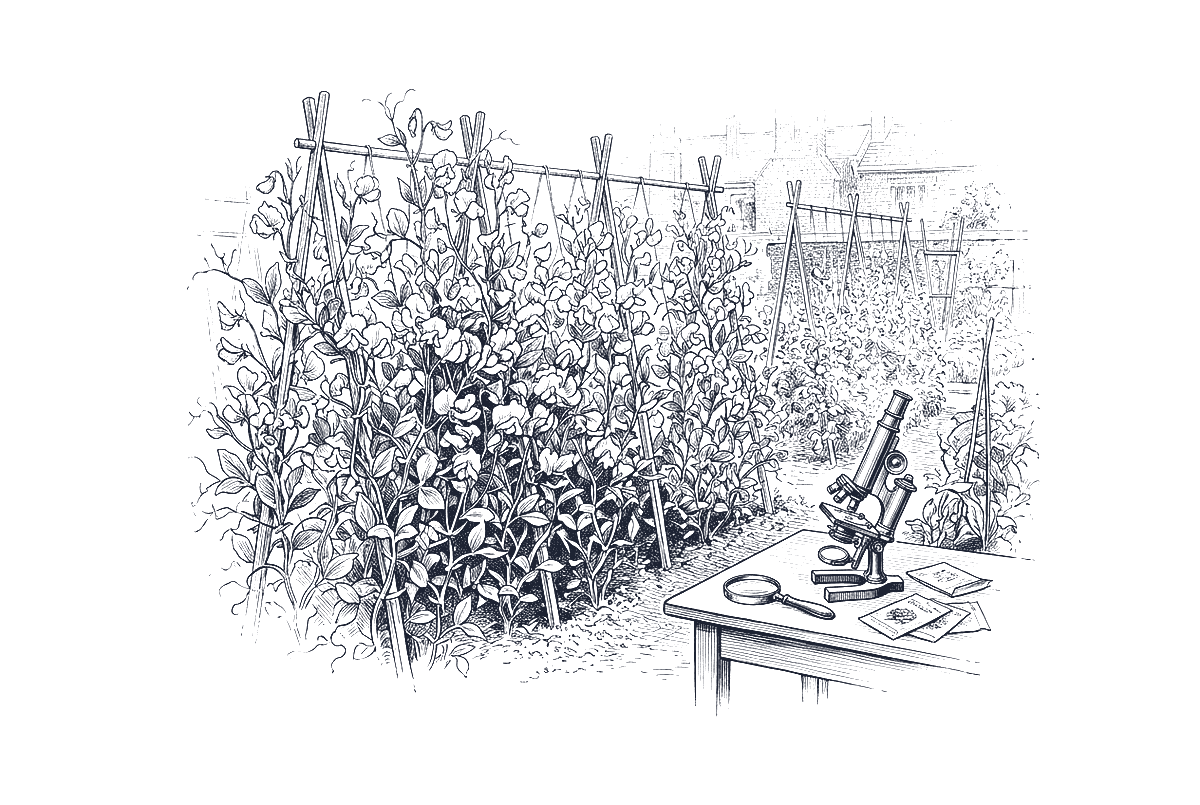
Linked genes in sweet peas
In 1900 Mendel's laws were rediscovered, and William Bateson in Cambridge became their loudest champion. With Edith Rebecca Saunders and, from 1904, Reginald Punnett, he crossed sweet peas to test the laws on new traits.
They followed two traits at once: flower colour (purple or red) and the shape of the pollen grains (long or round). By Mendel's second law, two traits are passed on independently, so a cross like theirs should give a 9 : 3 : 3 : 1 ratio.
What they found
Purple went with long pollen, and red with round, far more often than chance would explain. From their counts they worked out that about 7 in 8 pollen grains and egg cells kept the original pair. Bateson called it "coupling", but he could not explain it.
The answer came from Morgan's fly room in 1911: the two genes sit on the same chromosome, so they travel together, unless the two chromosomes of a pair swap pieces when pollen and eggs are made. Today this is called linkage.
Why it matters today
Linkage helps researchers find where disease genes are: they follow which stretch of a chromosome is passed on together with an illness in a family. In 1983 families with Huntington's disease led to its spot on chromosome 4; the gene itself was found in 1993. Linkage also tells plant and animal breeders which useful traits come as a package, and why some are hard to separate.
Questions and answers
What is genetic linkage?
Two genes are linked when they sit close together on the same chromosome. They are usually passed on together instead of independently, so they break Mendel's 9 : 3 : 3 : 1 ratio.
Who discovered linkage?
William Bateson, Edith Rebecca Saunders and Reginald Punnett described it in sweet peas in 1905–1906 and called it "coupling". In 1911 Thomas Hunt Morgan explained it from his fruit fly crosses: genes that lie close together on the same chromosome travel together.
Why do linked genes sometimes separate?
When pollen, eggs or sperm are made, the two chromosomes of a pair can swap pieces (crossing over). A swap between the two genes gives a new mix; the farther apart they are, the more often that happens. In these sweet peas about 1 grain in 8 carried a new mix.
How does linkage change the 9 : 3 : 3 : 1 ratio?
The combinations the F1 inherited (here purple with long, red with round) become more common and the new mixes rarer. In the 1906 sweet pea count, purple-long and red-round plants made up 1,909 of 2,132 coloured plants (about 90%) instead of the expected 62.5%.