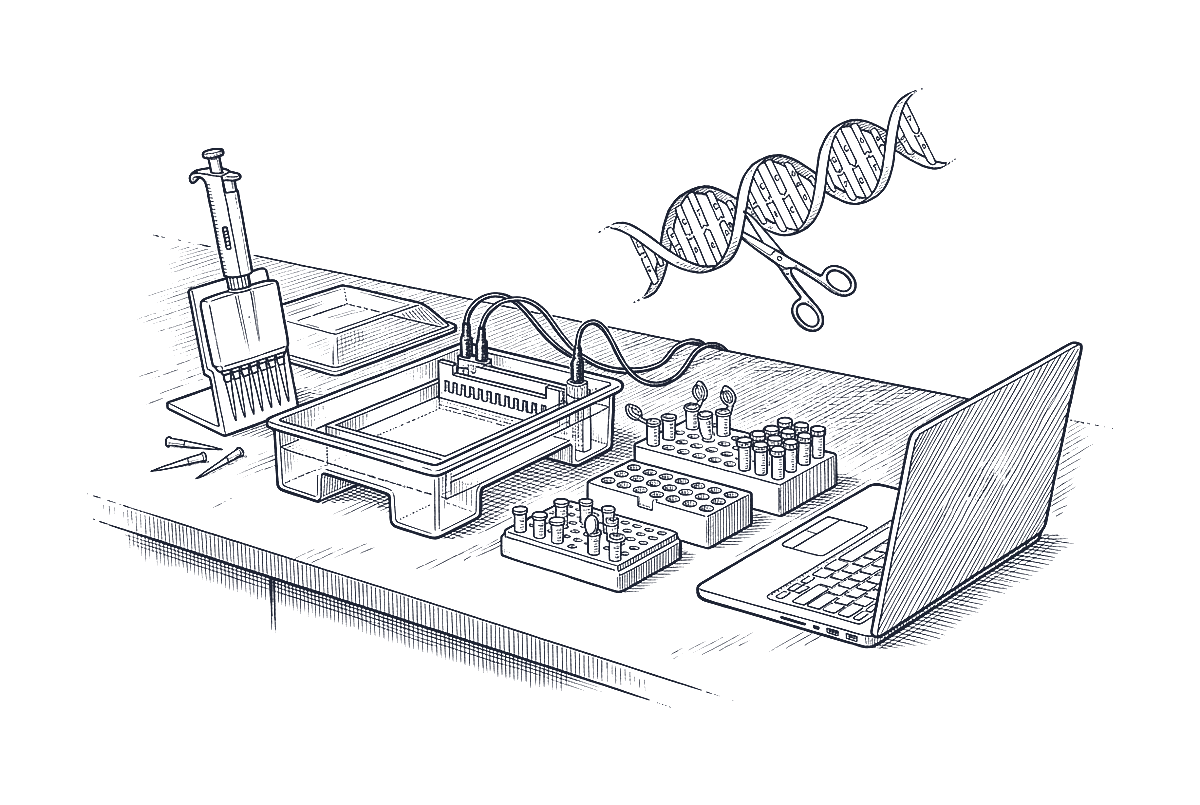
CRISPR: scissors you can program
Bacteria are attacked by viruses all the time. In the 1990s the Spanish microbiologist Francisco Mojica noticed odd repeated stretches of DNA in single-celled microbes, with short, different pieces squeezed between the repeats. In 2002 these repeats were given the name CRISPR. In 2005 Mojica's team and other groups reported that some of the pieces between the repeats match the DNA of viruses. The idea followed: a bacterium keeps a memory of the viruses it has met. In 2007 a team at a food company that makes yogurt cultures (Rodolphe Barrangou, Philippe Horvath and colleagues) showed it in the milk bacterium Streptococcus thermophilus: after a virus attack the cell added a new piece of virus DNA to its CRISPR, and became resistant to that virus.
The bacterium turns each remembered piece into a short RNA, a guide. The guide leads a protein, Cas9, along the DNA until it finds the matching place in the virus, and Cas9 cuts it there. In 2011 Emmanuelle Charpentier, who had found a second small RNA in the bacterium behind strep throat, teamed up with Jennifer Doudna, a biochemist in Berkeley. They took the system apart to see what it really needs.
What they found
Cas9 needs a guide RNA. A stretch of 20 of its letters pairs with the DNA, and Cas9 cuts both DNA strands only where those 20 letters match and a short signal, the PAM (for this Cas9: any letter, then G G), sits right next to them. The cut falls 3 letters before the PAM.
The two small RNAs of the bacterium can be joined into one single guide RNA. Change its 20 letters and Cas9 cuts somewhere else: scissors you can program. In 2012 they showed this in a test tube and wrote that it could be used to edit genes.
Why it matters today
In 2013, other labs showed that Cas9 can edit genes in human, mouse and plant cells. Today it is used in basic research to find out what genes do, and in crop research, for example toward plants that resist mould, pests or drought.
In November 2023 the United Kingdom and on 8 December 2023 the United States approved Casgevy, the first CRISPR medicine, for sickle cell disease. Doctors edit a patient's own blood stem cells and give them back. The edit disrupts a DNA switch for a gene called BCL11A. As new red blood cells develop they make more fetal haemoglobin, a healthy form of the oxygen-carrying protein, which makes the cells less likely to sickle and can prevent painful crises. Emmanuelle Charpentier and Jennifer Doudna received the 2020 Nobel Prize in Chemistry.
A word about ethics
Editing a patient's blood cells changes only that patient. If an edited egg, sperm or embryo leads to a birth, the child could pass the change on to their own children. In 2018 the researcher He Jiankui in China announced that twin girls had been born from edited embryos. Scientists around the world condemned it as unsafe and unnecessary, and in 2019 a Chinese court sentenced him to three years in prison. A 2020 survey found that most countries that have rules on this prohibit using edited embryos or reproductive cells to start a pregnancy, and none of them explicitly allows it. Some do allow research on edited embryos in the laboratory.
Questions and answers
What is CRISPR?
CRISPR is a pattern in the DNA of many bacteria: repeated sequences with short pieces stored between them. Many of those pieces come from viruses, so the pattern works like a memory of past infections. Bacteria use them, together with proteins such as Cas9, to recognise and cut viruses that attack again. Today the word often means the gene-editing tool built from this system in 2012.
How does Cas9 know where to cut?
A guide RNA leads Cas9; a stretch of 20 of its letters pairs with the DNA. Cas9 checks the DNA next to a short signal, the PAM (for the most used Cas9: any letter followed by GG). If the 20 letters of the guide pair with the DNA there, Cas9 cuts both strands, 3 letters before the PAM. No PAM, or a guide that does not match: no cut. (Real Cas9 can also cut at a near match, so scientists check for that. In this toy lab all 20 letters must pair.)
Is CRISPR used to treat people?
Yes. Casgevy, the first CRISPR medicine, was approved in the United Kingdom in November 2023 and in the United States on 8 December 2023 for sickle cell disease. A patient's own blood stem cells are edited in a laboratory and given back. Many other treatments are being tested in clinical trials.
How does a cell repair a cut, and what is a knockout?
A cut in DNA must be repaired. The quick way is to rejoin the ends. The cell may rejoin them exactly, or add or lose a letter or two. Because the cell reads genes three letters at a time, one extra or missing letter shifts all the letters after it, and the protein usually stops working: that is a knockout. The other way is to copy a template that is nearby. If scientists provide a correct template, the cell can use it to fix a typo, and a correction is more likely when the typo is close to the cut.
Is it allowed to edit human embryos?
Editing the cells of a patient who agrees to a treatment is regulated like any other medicine. Using edited embryos, eggs or sperm to start a pregnancy, so that changes can pass to children, is banned in most countries that have rules on it, because the risks are not understood and the person cannot agree. In 2018 a researcher in China did it anyway; it was widely condemned and he was sent to prison.